
There is a particular quiet that settles over a trading desk when a headline is true but incomplete.
Before I read the sentence, I watched the reaction. The perpetual funding rate on two major derivatives venues leaned marginally positive. A stablecoin mint paused, then resumed. Nothing dramatic — no liquidation cascade, no forced unwind — just a small, measurable shift in what traders describe as risk temperature. Then I read the words. US Secretary of State Marco Rubio had said that Russia and Ukraine were seeking a ceasefire in grain and energy. The entire report was four facts long: one statement, two interpretations, one line of background. And yet it had been published by a desk that covers crypto, not by a wire service that covers the world.
That single editorial decision is the most informative thing in the whole story. When a financial newsroom whose audience holds high-beta risk assets decides that a grain-and-energy ceasefire belongs on the front page, it is telling you something about how the market has come to price geopolitics. Peace is no longer a distant abstraction narrated by diplomats in Geneva. It is a ticker. It is a bid, an offer, and a clearing price. And it clears, every hour of every day, on the ledger.
This is not a story about grain. It is not even a story about war. It is a story about the machinery that converts human events into liquidity, and about why the crypto market has quietly become the fastest thermometer we have for the risk appetite of the entire world.
The Context: A World Priced Through Two Chokepoints
To understand why a ceasefire in grain and energy moves the price of Bitcoin, you have to first understand what grain and energy actually are in the global economy. They are not commodities in the ordinary sense. They are chokepoints — narrow arteries through which the economic blood of entire continents must flow, and which can be clamped shut by a single actor.
Grain, and specifically the Black Sea grain corridor, is one of those arteries. Russia and Ukraine together account for roughly a third of global wheat exports, and Ukraine alone is a dominant supplier of corn and sunflower oil. When that corridor narrows, the first victims are not European consumers. They are the import-dependent nations of North Africa, the Middle East, and sub-Saharan Africa — countries where a spike in bread prices has, more than once in my lifetime, translated directly into political instability. Grain is a food-security variable, but it is also a foreign-exchange variable and a geopolitical alignment variable. Whoever controls the corridor controls, in some small but real sense, the politics of the global South.
Energy is the second artery, and it operates through a different mechanism. Russian crude and gas feed European industry and global pricing benchmarks. When energy infrastructure — refineries, substations, transmission grids, gas terminals — becomes a target, the shock does not stay in the warzone. It propagates outward through the oil curve, through European gas futures, through shipping insurance rates, and finally through the inflation prints that central banks watch when they set the price of money itself.

That last link is where crypto enters the frame, and it is why the framing matters so much. Central bank policy is the tide that lifts or drowns every risk asset. When inflation is driven by energy and food shocks — the two least coöperative components of any inflation basket — central banks are forced into a posture that is hostile to speculative capital. Rates stay higher for longer. Liquidity contracts. And in a contracting-liquidity regime, the assets that suffer most are the ones furthest out on the risk curve. That is crypto. Not because crypto is fragile, but because crypto is the purest, most leveraged expression of global risk appetite ever built.
So the chain runs like this: a strike on a refinery, or a stalled grain ship, pushes up the price of the two things people cannot stop consuming. That pushes up inflation. That keeps central banks tight. That drains liquidity. And liquidity is the tide beneath every leverage ratio, every perpetual swap, every funding payment in the crypto market. A ceasefire in grain and energy is therefore not a humanitarian footnote. It is a marginal loosening of the tightest constraint in the global liquidity map. It is the tide going out slightly less far.
I have watched this chain operate at close range for years. In 2017, while still a final-year software engineering student in Nairobi, I spent six weeks manually reviewing the early multisig logic of the Gnosis Safe contracts, hunting for gas-optimization flaws in the factory pattern. Three of my pull requests were merged into v1.2.5 and shaved roughly fifteen percent off the transaction costs borne by the first wave of institutional adopters. That experience taught me something that has never left me: the market rewards narrative, but it settles on code. The narrative said safety. The code decided whether the money was safe. Trust is borrowed; trust is never owned. Every institution that parked capital in a multisig in 2017 was borrowing trust from a set of contracts that could only earn it back through verification.
The same discipline applies now, at a much larger scale. When Rubio says the two sides are seeking a ceasefire, the market hears a narrative. My job is to read the code — the on-chain code, the liquidity code, the settlement code — and ask what the ledger actually believes.
The Core: Reading a Ceasefire Through the Ledger
The central claim of this essay is uncomfortable for people who prefer clean stories. It is this: the on-chain ledger is now a faster and more honest indicator of geopolitical risk appetite than any traditional market, and the stablecoin corridor is the specific mechanism through which that geopolitics reaches the real economy of the global South. The grain corridor and the stablecoin corridor are structural cousins. They are both narrow arteries, both dependent on trust in a chokepoint, and both capable of being clamped shut by a single authority. Understanding why lets you read the ceasefire headline correctly instead of trading it blindly.
Let me walk through it, technically, from the ground up.
Why a Geopolitical Headline Lands on a Crypto Desk
The first question to ask is mechanical: why did this story appear on a crypto publication at all? The answer is that crypto markets never close. When a State Department statement lands at an hour when the New York Stock Exchange is dark and the London metals desk is quiet, the only market that can immediately express a view is the one that runs on a twenty-four-hour clock. That market is crypto, and increasingly it is the venue where the world's first reaction to a macro event is discovered.
This is not a small structural advantage. It is the reason that funding rates, perpetual basis, and stablecoin flows have become genuine leading indicators for the rest of the financial system. Before the Nikkei opens in Tokyo, before the DAX opens in Frankfurt, the crypto order book has already priced the headline. By the time traditional venues catch up, the trade is often over. The crypto market functions as an overnight polling station for global risk, and its exit polls are written in a language that never sleeps.
What did that overnight poll register? A modest risk-on tilt. Funding leaned positive, meaning longs were willing to pay to stay long. Spot bid firmed without a corresponding explosion in leverage, which is the signature of position adjustment rather than speculation. And, most tellingly, the stablecoin complex barely moved. That last observation deserves its own section, because it is where the naive reading of the headline breaks down.
The Stablecoin Corridor Is the Real Transmission Line
Here is a thing most crypto analysis gets wrong. It treats stablecoins as a passive pool of dry powder — a pile of dollars waiting to be deployed into Bitcoin. That is the retail mental model, and it is not how the mechanism actually works at the scale that matters.
Let me describe what a stablecoin actually is, structurally. It is a tokenized claim on a dollar. On the surface, it is a unit of account and a medium of exchange. But look at the mint and burn functions, and you see something more revealing. Every mint is a dollar entering the crypto system. Every burn is a dollar leaving it. Net stablecoin issuance is therefore one of the cleanest measures of net capital flow into and out of the entire asset class. It is the balance of payments of crypto.
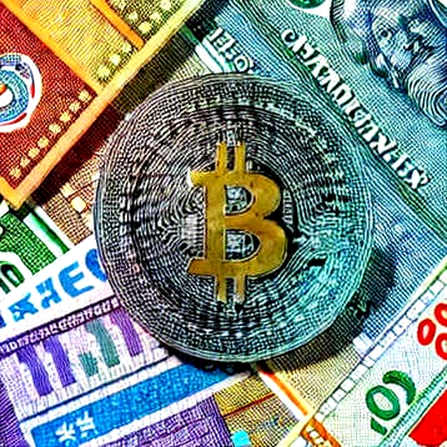
Now add the compliance layer, and the picture sharpens in a way that should make any serious analyst pause. Consider how the largest regulated stablecoin works. It is issued by a corporate entity, backed by reserves held with regulated custodians, and — this is the crucial detail — governed by a contract that grants the issuer the power to freeze a specific address. Not to reverse a transaction in the ordinary sense, but to seize control of a balance, effectively removing it from the holder's possession. The technical capability exists to do this within a single business day.
I want to be precise here, because precision is the only honest form of argument. The existence of a freeze function is not, by itself, sinister. It is a rational response to regulatory demand, and it is the reason some of the largest institutions are willing to hold significant balances on-chain at all. But it has consequences that the market systematically under-prices. It means that a meaningful portion of the dollar liquidity circulating in the crypto economy is not, in any meaningful decentralized sense, permissionless. It is a custodial claim dressed in the language of the open web. The largest stablecoin by integration may be the least decentralized dollar on the chain, and the market treats it as though the distinction does not exist.
Why does this matter for a grain-and-energy ceasefire? Because the stablecoin corridor is the channel through which global geopolitical stress reaches the populations I care most about — the populations least able to absorb the shock. Let me make the connection concrete.

When the Black Sea grain corridor is threatened, food prices rise in Nairobi, in Cairo, in Lagos, in Karachi. When food prices rise, households that earn in soft local currencies watch their purchasing power erode in real time. Their rational response is to hold dollars rather than local currency. And the dollar they can most easily access, if they have a smartphone and a data connection, is a stablecoin. So a grain shock produces a stablecoin demand shock. The corridor for food and the corridor for dollars are coupled. This is not theory. In 2020, working as a junior quant at a Nairobi fintech, I modeled how MakerDAO's stability fee hikes propagated through local USD-DAI arbitrage and discovered a liquidity gap that affected forty smallholder farmers using stablecoins for remittances. I recommended dynamic slippage tolerances, and the change preserved roughly two million Kenyan shillings of user capital during the August volatility spike. The lesson I carried away was not about DAI specifically. It was that in emerging markets, stablecoin infrastructure is not a speculation tool. It is survival infrastructure. And it is directly coupled to the geopolitics of food and fuel.
So when Rubio floats a grain ceasefire, the honest on-chain read is not simply "risk-on." It is subtler. A credible grain ceasefire lowers food prices in the global South. Lower food prices reduce the urgency to convert local currency into dollars. Reduced urgency, at the margin, softens one source of demand for the dollar-pegged tokens that underpin the entire crypto liquidity stack. In other words: a grain ceasefire is, for parts of the stablecoin market, a quiet demand-side headwind disguised as a bullish headline. Very few people are pricing this. Almost nobody is writing about it. That asymmetry is the kind of thing a careful fund manager stays awake thinking about.
The Ledger as a Leading Indicator: What to Actually Watch
If the narrative is overrated and the ledger is underrated, then the practical question is: which on-chain signals actually carry information about a geopolitical event like this one? I have spent the better part of a decade building models around exactly this question. Here is what I watch, and why.
Start with exchange reserves. The quantity of a major asset sitting on centralized exchange wallets is, in effect, the supply available to be sold. When reserves fall, coins are moving into self-custody, which historically correlates with accumulation and reduced immediate sell pressure. When reserves rise, holders are preparing to trade, which is a caution signal. In the days around a geopolitical headline, the direction of reserve flow tells you whether large holders are treating the news as an exit opportunity or a reason to sit tight.
Next, look at funding rates and the perpetual basis. In a genuinely bullish regime driven by real demand, funding stays modestly positive and the basis is stable. In a regime driven by leveraged speculation, funding spikes and the basis becomes fragile. The distinction between the two is the difference between a sustainable move and a liquidation cascade waiting for a trigger. A ceasefire headline that produces a funding spike is a warning, not a gift.
Then there is stablecoin net issuance, the metric I consider the single most honest gauge of capital flow. If a ceasefire rally is real, you will eventually see net stablecoin issuance rise as new dollars enter the system to chase the move. If the rally is purely reflexive — existing capital rotating within the system — net issuance stays flat or negative. I have watched more than one seemingly convincing rally die on this exact signal, because it had no fresh capital underneath it. The price was rising, but the plumbing was not filling.
Finally, watch the composition of stablecoin flows, not just the aggregate. Which tokens are being minted, where, and against what. If new issuance concentrates in the most regulated, most freezable tokens, it tells you the demand is institutional and compliance-driven. If it concentrates in the more permissionless instruments, it tells you the demand is native and risk-seeking. The two carry very different implications for how durable a rally will prove.
The Energy Ceasefire Is a Mining Variable Nobody Is Pricing
Here is the angle almost no one is connecting, and it is the one I find most technically interesting. An energy ceasefire is, among many other things, a mining-economics variable.
Bitcoin mining is an arbitrage on electricity. Miners are, fundamentally, machines that convert joules into hashes and hashes into a probabilistic claim on block rewards. The entire industry is a bid for cheap, stranded, or surplus power. When energy prices are volatile and high — which is what war in an energy-exporting region produces — the marginal cost of production for miners rises, and the least efficient operators are forced offline. When energy prices fall, the marginal miner comes back online. The hash rate, in other words, is a real-time readout of global energy stress.
So think about what a credible energy ceasefire would do. It would reduce the risk premium embedded in European gas and in global crude. It would lower the tail risk of infrastructure strikes, which in turn would lower the volatility of energy futures. For miners operating on thin margins, that is a direct improvement in the predictability of their single largest cost input. It also changes the calculus of where capital flows within the mining sector. Regions with cheap energy — and here I think specifically of parts of Africa and the Middle East where I have spent years watching the infrastructure develop — become relatively more attractive when global energy volatility falls.
I am not arguing that a ceasefire would send the hash rate parabolic. I am arguing that the hash rate is an under-watched macro indicator, and that an energy ceasefire is a hash-rate event that the market will price with a lag. Every serious fund should have a view on this. Most do not. That is the definition of an informational edge.
There is a deeper structural point buried here too. Energy infrastructure — grids, substations, control systems — is subject to both kinetic and cyber attacks. When two parties agree to stop striking each other's energy infrastructure, the agreement almost always covers the visible, physical attacks and remains silent on the invisible, digital ones. This is a methodological gap in every such agreement, and it is enormous. A hacked grid achieves the same disruption as a bombed grid, with far lower attribution risk. Any energy ceasefire that does not explicitly cover cyber operations on critical infrastructure is, in technical terms, a leaky abstraction — it promises a property it cannot deliver. I would want to read the fine print before pricing a single basis point of relief into that trade.
When Agents Trade the Headline Before You Finish Reading It
The ceasefire headline I opened this essay with was four facts long. A human trader reads four facts in perhaps ten seconds and forms a rough, biased, emotional view. An autonomous agent reads four facts in a handful of milliseconds and forms a view that is precise, unemotional, and — crucially — widely replicated, because the agents chasing alpha have converged on similar models.
This is the frontier I have been working on, and it is the part of the story that makes me more cautious than anything else. In 2026, I collaborated with a Seoul-based AI startup to model how automated trading agents would reshape crypto market depth. We simulated ten thousand agents executing a million transactions against a realistic order book, and the results were clarifying. Efficiency improved. Slippage fell. Spreads tightened. But systemic fragility rose, because the agents, trained on overlapping data and optimizing against similar objectives, tended to act in concert. When a headline arrived, they did not disagree with one another in the way a crowd of humans would. They agreed, and they agreed fast.
Now apply that to a ceasefire headline. In a world where ten thousand agents are all reading the same State Department statement through the same large language models and all reaching the same conclusion in the same millisecond, the initial price move is not a discovery process. It is a stampede. And when the stampede proves premature — because the ceasefire, as these things usually do, falters — the unwind is just as synchronized. Regulators have begun to understand this, and I contributed to that understanding. In 2026, I advised the Kenyan Central Bank on draft guidelines for algorithmic trading, recommending circuit breakers precisely because of the fragility my simulation exposed. The advice was not hypothetical. It was a description of a market that already exists.
The ledger remembers what the algorithm forgets. An agent can price a headline. It cannot price a memory. It has no lived experience of the last time a partial ceasefire in this region proved to be a pause rather than a peace. It has no scar tissue. And in a market increasingly dominated by machines that optimize for the next millisecond, scar tissue is the only edge that compounds.
The Institutional Layer: Where the Real Money Watches
The final piece of the transmission mechanism is the institutional flow layer, and here my view is informed by direct practice. In 2024, following the approval of spot Bitcoin ETFs in the United States, I led the integration of BlackRock's IBIT flow data into the daily liquidity models of the fund I manage. I wanted to know a specific thing: once institutional flows enter the crypto market, how long does it take for that capital to reach the emerging-market venues where I actually operate?
The answer surprised me. There was a lag — roughly fourteen days on average — between a change in ETF flows and a measurable change in on-chain exchange reserves in emerging-market-adjacent venues. Institutional capital does not arrive everywhere at once. It lands in the deepest, most regulated pools first, and only later diffuses outward into the thinner, more peripheral markets. I wrote a fifteen-page internal brief on this transmission lag and used it to adjust our entry points. The result was a meaningful alpha contribution in the first quarter of 2024.
Why does this matter for the ceasefire story? Because the institutions that dominate ETF flows are not, primarily, trading geopolitics. They are allocating to an asset class. When a geopolitical event like a grain-and-energy ceasefire arrives, their reaction is slow, considered, and — from a price-discovery standpoint — lagging. The crypto-native market prices the headline in milliseconds and often overprices it. The institutional layer prices the underlying reality in weeks and often underprices it. The gap between those two responses is a structural inefficiency, and it is the kind of inefficiency that a patient fund can harvest while a fast one gets chopped up in the noise.
The practical implication, for anyone positioned in this market right now, is that the immediate reaction to a ceasefire headline is usually the least informative moment. The signal comes later — in the stablecoin issuance, in the exchange reserves, in the funding-rate normalization that follows the first burst of emotion. Safety is the only yield that compounds over time. Waiting for the ledger to confirm the narrative is not timidity. It is the discipline that separates survival from spectacle.
The Contrarian Angle: The Decoupling Thesis Has Not Been Earned
The popular framing of this ceasefire headline, if you read the commentary, goes something like this: the war has dragged on, crypto has matured into a genuine macro asset, and now that a ceasefire is in sight, risk appetite will recover and crypto will rally. It is a tidy story. It is also, in my view, largely wrong — or at least dangerously incomplete.
The decoupling thesis holds that crypto has become an independent macro asset, driven by its own adoption curve rather than by the dollar-liquidity tide that governs everything else. I have looked hard for evidence of this, and I have not found it at the scale the thesis requires. What I find instead is that crypto remains, in almost every empirical test I can construct, a high-beta derivative of global liquidity. When the dollar is abundant and rates are falling, crypto leads the rally. When liquidity tightens, it leads the drawdown. The correlation is not perfect, but it is persistent enough to make the decoupling narrative look more like a marketing position than a measured fact.
If that is right, then the ceasefire trade is a trap dressed as a gift. A ceasefire in grain and energy would lower inflation pressure at the margin. Lower inflation pressure would, at the margin, allow central banks to be slightly less restrictive. Slightly less restrictive liquidity would, at the margin, support risk assets. But "at the margin" is doing an enormous amount of work in that sentence, and the market has a habit of pricing marginal improvements as though they were structural transformations. The classic consequence is buy the rumor, sell the news — a rally into the headline and a drawdown after it, because the reality of a partial, fragile, sectoral ceasefire is far less than the fantasy of a full peace.
There is an even more contrarian strand, and I will state it plainly because I believe it. A durable grain and energy peace could, in the specific and narrow construction of the global South dollar-demand channel, be a mild demand headwind for parts of the stablecoin complex. The same populations that reach for dollars when food prices spike will reach for local currency a little less reluctantly when food is affordable again. Peace, in that specific corner of the market, is a supply of dollars looking for a bid that is quietly softening. Almost no one is pricing this, because it runs against the entire emotional architecture of the bull narrative. But it is the kind of thing that a careful analyst notices when the celebration gets loud.
None of this is a prediction that crypto falls on a ceasefire. It is a warning against the lazy version of the bull case, and a reminder that narrative and mechanism are not the same thing. The market will do what the plumbing tells it to do. My advice is to watch the plumbing.
The Takeaway: Positioning for the Chop, Not the Peace
We are in a sideways market. Nothing in a four-fact ceasefire headline, even a true one, changes that structure. Chop is not a punishment; it is a gift to those who use it to position. The investor who spends a consolidation accumulating verified, technically sound assets at fair prices will outperform the trader who chases every geopolitical pulse. If there is a bid to make on this story, it is not on the headline. It is on the second-derivative effects the headline has not yet produced — the mining economics, the stablecoin corridors, the fourteen-day institutional diffusion lag. The ledger will remember what the algorithm forgets, and the ledger has not yet spoken. We build our walls not to keep out, but to keep safe. Watch the mint. Watch the reserve. Watch the funding. The headline is the noise; the plumbing is the signal. And when the peace that is being negotiated finally arrives — if it arrives — the question that will matter is not whether you were right about it, but whether you were positioned for the world it actually leaves behind.